A good dog bed isn’t a luxury — it’s a basic requirement for your dog’s comfort, joint health, and sleep quality. But with hundreds of options available in the UK, from £15 supermarket beds to £200 orthopaedic designs, finding the right one for your dog’s size, age, and sleeping style can be surprisingly difficult. We’ve tested over 20 dog beds across all size categories, from Chihuahua to Great Dane, evaluating them on comfort, durability, washability, and whether dogs actually choose to sleep on them. Here’s what we found.
Why Your Dog’s Bed Actually Matters
The RSPCA recommends providing dogs with a comfortable, clean bed as part of their basic welfare needs. Dogs spend 12-14 hours a day sleeping — even more for puppies and senior dogs, as noted by the RSPCA. The surface they sleep on directly affects their joint health, particularly as they age. Dogs sleeping on hard floors or thin, compressed beds develop calluses on their elbows and hocks. A balanced diet — whether kibble or raw feeding — also plays a role in joint health, and older dogs can develop or worsen arthritis symptoms.
A properly supportive bed does three things (and combined with regular dental care at home, it’s a cornerstone of your dog’s daily wellbeing): it cushions pressure points (elbows, hips, shoulders), insulates from cold floors (particularly important in UK homes with tiled kitchens or draughty hallways), and provides a sense of security — a space that’s definitively “theirs.” The right bed can also help with behavioural issues; a dog that has a comfortable, established sleeping spot is less likely to claim your sofa or bed.
How We Tested
We distributed beds to a panel of dog owners across the UK over a three-month period, covering breeds from Miniature Dachshunds to Newfoundlands. Each bed was used as the dog’s primary bed for at least four weeks, and owners reported on:
- Dog preference — did the dog actually choose to sleep on it? This is the ultimate test that no lab measurement can replace
- Support quality — did the bed maintain its shape and cushioning over time, or compress flat?
- Durability — how did it hold up to digging, nesting, chewing, and general dog use?
- Washability — could the cover be machine washed? How well did it survive multiple washes?
- Odour resistance — all dogs smell, but some bed materials harbour smells worse than others
- Value for money — longevity and quality relative to price
Best Overall: Omlet Topology Dog Bed
The Omlet Topology is a modular dog bed system that’s cleverly designed for both dogs and their owners. The base is a solid memory foam mattress raised on feet (keeping it off cold floors and improving airflow underneath), and you can buy interchangeable toppers — from quilted covers to sheepskin to waterproof options — that zip on and off for washing.
This modular approach solves the two biggest problems with dog beds: washing and longevity. Instead of wrestling an entire bed into the washing machine, you unzip the topper and wash just that. When a topper wears out, you replace it for £20-40 rather than buying a whole new bed. The memory foam base itself is high-density and showed minimal compression even after three months of daily use by a 35kg Labrador.
Available in sizes from Small (for dogs up to about 10kg) to Large (suitable for dogs up to 45kg), the Topology ranges from about £100 to £200 depending on size and topper choice. It’s not cheap, but the modular design means the overall cost of ownership is actually lower than replacing cheaper beds every 6-12 months. Omlet is a UK company based in Oxfordshire, and after dealing with them directly for replacements and queries, we can confirm their customer service has been excellent.
Best Budget: Pets at Home Oval Bolster Bed
Not everyone wants to spend £150+ on a dog bed, and that’s perfectly reasonable. The Pets at Home own-brand Oval Bolster Bed (from about £20-40 depending on size) is a solid budget option that outperforms its price tag. The bolster sides give dogs something to rest their heads on, the filling is adequate (not luxurious, but decent), and the entire bed is machine washable.
The honest trade-offs at this price: the filling will compress faster than memory foam alternatives, typically needing replacement every 8-12 months with heavy use. The fabric isn’t as durable as premium beds, and determined chewers will destroy it. But as a first bed for a puppy, a secondary bed for a second room, or a budget option for a small dog that’s gentle with their belongings, it does the job well. The ability to pick one up in-store and take it home immediately is a practical advantage too.
Best for Large Breeds: Big Dog Bed Company Original
Large and giant breeds have specific needs that many generic “large” dog beds simply don’t meet. A Labrador, German Shepherd, or Great Dane needs a bed with enough surface area to sprawl out fully, foam dense enough to support 40-70kg+ without bottoming out, and construction robust enough to handle the additional wear that comes with large dogs.
The Big Dog Bed Company (a small UK manufacturer based in Yorkshire) makes beds specifically for large breeds, and it shows. Their Original bed uses high-density orthopaedic foam that’s noticeably thicker and firmer than standard pet bed foam. The covers are tough, machine-washable cotton drill fabric, and the zip is deliberately placed underneath to prevent dogs from finding and chewing it.
Sizes go up to XXL (150cm x 100cm), which comfortably fits even a stretched-out Great Dane. Prices range from about £80 to £160 depending on size. The wait time can be 1-2 weeks as beds are made to order, but the quality justifies the patience. For anyone with a dog over 30kg, this is our top recommendation.
Best for Senior Dogs: Snoozer Orthopaedic Cozy Cave
Senior dogs with arthritis or joint stiffness benefit enormously from orthopaedic memory foam, and many also prefer enclosed or hooded beds that retain warmth. The Snoozer Orthopaedic Cozy Cave combines both — a thick memory foam base with a hooded cover that creates a warm, den-like space. For a related angle, see our Best Cat Beds 2026 UK: Igloo, Radiator & Heated Options guide.
The memory foam base provides genuine pressure point relief, distributing your dog’s weight more evenly than fibre-fill beds. The hooded design isn’t just a gimmick — many dogs naturally prefer to sleep in enclosed spaces (it’s an instinctive denning behaviour), and the hood retains body heat, which is particularly comforting for older dogs who feel the cold more. We saw several test dogs who had been reluctant to use open beds immediately take to the Cozy Cave.
At around £90-140 depending on size, it’s a worthwhile investment for any senior dog. The cover is removable and machine washable, though the hood design makes washing slightly less convenient than a simple flat bed. Available in multiple sizes from small to extra-large, fitting dogs from Spaniels to Retrievers.
Best for Puppies: Kong Lounger
Puppy beds need to be cheap, durable, and washable — because puppies will chew them, pee on them, and drag them around the house. The Kong Lounger (around £25-40) hits all three requirements. The fabric is reinforced and more chew-resistant than standard pet beds, the bolster sides are popular with puppies who like to nestle, and the entire bed goes in the washing machine.
We wouldn’t claim any bed is truly puppy-proof — a determined puppy will destroy anything given enough time and boredom. But the Kong Lounger survived notably better than budget alternatives in our testing, with reinforced seams and denser fabric that resisted casual chewing. At this price point, when (not if) the puppy eventually damages it, you haven’t lost a significant investment.
Avoid buying an expensive orthopaedic bed for a puppy. They’ll outgrow it, potentially destroy it, and their young joints don’t need the same support as adult dogs. Wait until they’re fully grown to invest in a long-term bed.
Best Waterproof: Danish Design Waterproof Box Duvet
For dogs that swim, roll in mud, or have incontinence issues, a waterproof bed is essential rather than optional. The Danish Design Waterproof Box Duvet (around £40-70) uses a genuinely waterproof fabric that’s also surprisingly comfortable — it doesn’t have the crinkly, plasticky feel of cheaper waterproof beds. Our How to Tell If Your Dog Is Overweight guide is useful alongside this.
The box design with raised sides contains mess and gives dogs a defined space, while the duvet cushion is thick enough for comfortable everyday use. It wipes clean easily and the inner can be machine washed when needed. Danish Design is a well-established UK brand with good availability from independent pet shops, Pets at Home, and Amazon.
If your dog regularly comes in from walks wet and muddy (which in the UK is roughly nine months of the year), having a waterproof bed in the hallway or utility room saves your furniture and carpets while giving your dog somewhere comfortable to dry off.
Dog Bed Types: Which Style Suits Your Dog?
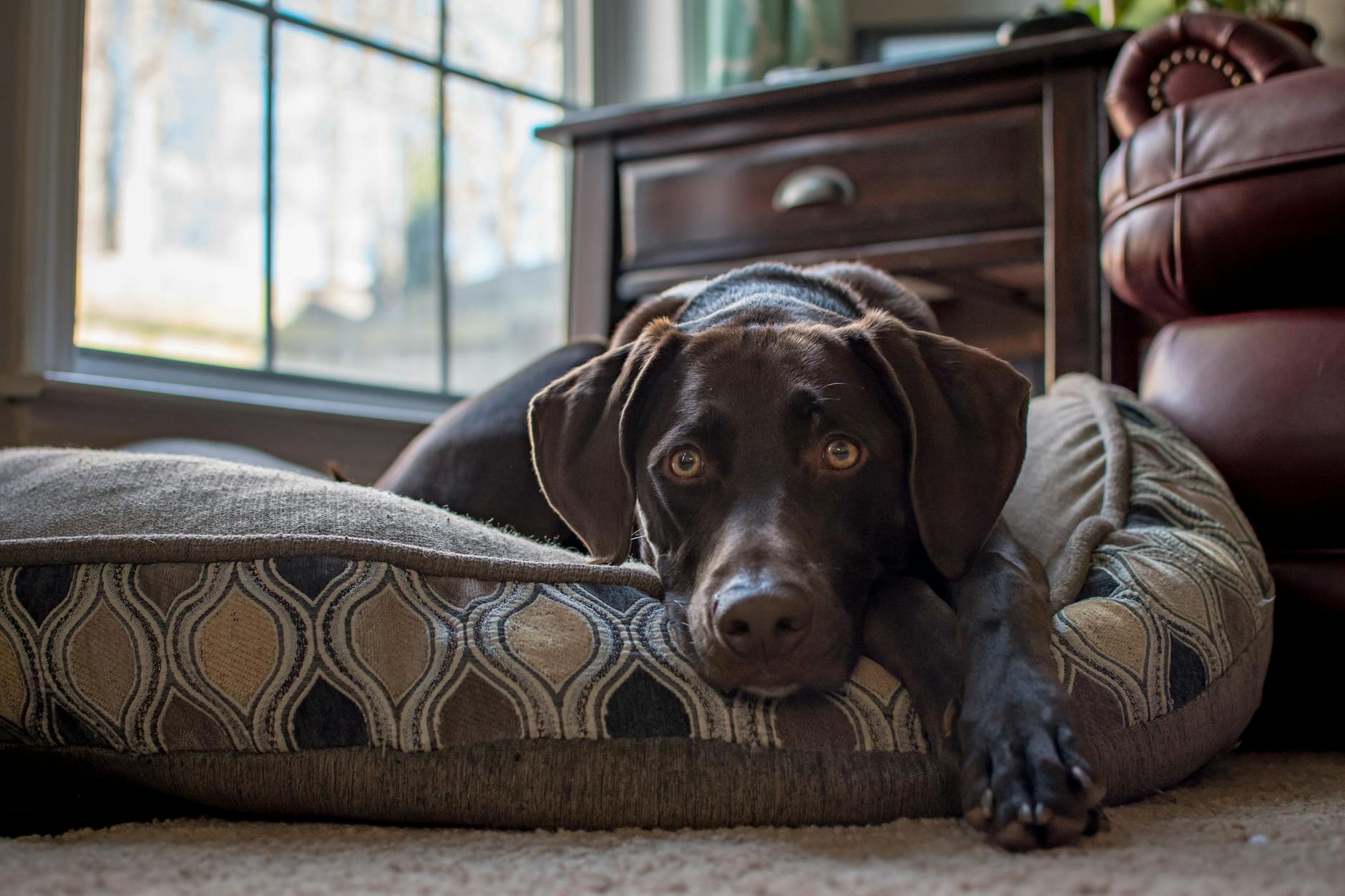
Dogs have sleeping preferences just like humans. Matching the bed style to your dog’s natural sleeping position makes it far more likely they’ll actually use it:
- Bolster/nest beds — beds with raised sides. Best for dogs that curl up or like to rest their head on something. Popular with terriers, spaniels, and most small-to-medium dogs
- Flat mattress/mat beds — simple flat cushions without sides. Best for dogs that sprawl out flat, typically larger breeds like Labradors, Greyhounds, and Great Danes
- Cave/hooded beds — enclosed beds that create a den-like space. Best for dogs that like to burrow under blankets, including Dachshunds, Whippets, and many smaller breeds
- Elevated/raised beds — fabric stretched over a frame, like a trampoline-style bed. Best for dogs that overheat, as air circulates underneath. Popular in warmer months and for breeds prone to overheating like Bulldogs and Pugs
- Donut/round beds — circular beds with soft, raised edges all around. Best for dogs that like to curl into a tight ball, often smaller breeds and anxious dogs who find the enclosed feeling comforting
Watch how your dog naturally sleeps before choosing a style. If they stretch out flat on the floor, a bolster bed is wasted. If they always curl up against the sofa arm, a bolster or cave bed mimics that support.
Getting the Size Right
Sizing a dog bed correctly is simpler than most brands make it seem. Measure your dog from nose to tail base while they’re sleeping in their natural position, then add 15-20cm. That’s the minimum internal length you need. For width, measure from their back to their paws when lying on their side, and add 10-15cm.
Common sizing mistakes:
- Buying too small — by far the most common error. A dog in a too-small bed will overhang the edges, sleep on the floor instead, or look uncomfortable. When in doubt, size up
- Measuring the outside of the bed — the dimensions listed by manufacturers are usually external measurements. A bed listed as 80cm may only have 65cm of usable internal space once you account for bolster sides
- Not accounting for the sleeping position — a dog that curls up tightly needs less bed than a dog that sprawls flat. Base your sizing on their actual sleeping position, not just their body length
- Forgetting puppies grow — if buying for a puppy, buy for their expected adult size or use an affordable bed they’ll outgrow
What About Orthopaedic and Memory Foam?

The term “orthopaedic” is used very loosely in the pet bed industry — there’s no regulation requiring a minimum foam density or quality standard. A £30 bed labelled “orthopaedic” may contain thin, low-density foam that offers little more support than standard filling.
Genuine orthopaedic support requires high-density memory foam (at least 40kg/m³ density) in a thickness of at least 7-10cm. This is the type of foam that actually moulds to your dog’s body shape and distributes pressure evenly. Budget “orthopaedic” beds with thin foam layers or shredded foam don’t provide the same benefit. We cover a similar decision in How to Train a Puppy: The First 8 Weeks at Home.
Memory foam dog beds are most beneficial for:
- Senior dogs (7+ years) — ageing joints benefit most from pressure-relieving support
- Large and giant breeds — heavier dogs compress standard filling more, so higher-density foam maintains support better
- Dogs with diagnosed arthritis or joint conditions — your vet may specifically recommend an orthopaedic bed
- Dogs recovering from surgery — particularly orthopaedic surgery like cruciate ligament repair
For healthy, young-to-middle-aged dogs, standard quality filling is perfectly adequate. Don’t feel pressured into buying a memory foam bed for your energetic two-year-old Spaniel — they’ll be fine on a decent conventional bed and probably prefer the flexibility of a softer filling to the rigid support of memory foam.
Cleaning and Maintenance
Dog beds get dirty quickly. Hair, drool, mud, and that distinctive “dog smell” accumulate faster than most people anticipate. Good maintenance extends the life of any bed and keeps your home more hygienic.
- Vacuum the bed weekly — removes hair and dust mites before they build up. A handheld vacuum or the upholstery attachment on your regular vacuum makes this quick
- Wash the cover fortnightly — or weekly if your dog is particularly dirty or has skin conditions. Always check the care label; most quality beds have removable, machine-washable covers
- Air the foam insert monthly — take the foam core outside on a dry day to air out. This prevents moisture build-up inside the foam that can lead to mildew
- Use a waterproof liner — if your bed doesn’t have one built in, a waterproof mattress protector (human baby ones work perfectly) between the foam and the cover protects the core from accidents and extends its life considerably
- Spot clean accidents immediately — enzymatic cleaners (like Simple Solution or Bio-One) break down organic matter and eliminate odours that standard cleaning products just mask
Where to Put Your Dog’s Bed
Location matters more than most owners realise. Dogs are social animals but also need a space that feels secure and calm. The ideal placement balances these needs:
Place the bed in a room where the family spends time, but in a quieter corner away from heavy foot traffic and doorways. Avoid placing beds directly next to radiators (overheating) or external doors (draughts). Slightly elevated positions (not literally elevated, but away from the coldest floor areas) help insulate from cold — tiled kitchen floors in UK homes can be bitterly cold in winter.
Many owners find that having two beds — one in the main living area for daytime use and one in the bedroom or hallway for night-time — helps establish a good routine. This doesn’t need to be expensive; the daytime bed can be higher quality while the night-time bed can be a simpler, budget option.
Frequently Asked Questions
What is the best dog bed in the UK? Based on our testing, the Omlet Topology is the best overall dog bed for UK homes. Its modular design with interchangeable, washable toppers and a high-density memory foam base offers excellent long-term value. For large breeds, the Big Dog Bed Company Original is our top pick.
How big should a dog bed be? Measure your dog from nose to tail base while sleeping, then add 15-20cm. For width, measure from back to paws when lying on their side and add 10-15cm. When in doubt, always size up rather than down.
Are orthopaedic dog beds worth it? Orthopaedic memory foam beds are most beneficial for senior dogs over 7 years old, large breeds, and dogs with arthritis or joint conditions. For healthy young dogs, a standard quality bed is perfectly adequate. Look for foam density of at least 40kg/m³ for genuine orthopaedic support.
How often should you wash a dog bed? Vacuum the bed weekly and wash the cover every one to two weeks. Air out the foam insert monthly on a dry day. Use enzymatic cleaners for any accidents, and consider a waterproof liner between the foam and cover to extend its lifespan.
What type of dog bed is best for puppies? A durable, washable bed like the Kong Lounger (around £25-40) is ideal for puppies. Avoid expensive orthopaedic beds at the puppy stage — they will likely chew it and outgrow it. Save the investment in a premium bed for when they reach adult size.
The Bottom Line
The right dog bed depends on your dog’s size, age, sleeping style, and your budget. The Omlet Topology is our top overall pick for its clever modular design, genuine quality, and long-term value. For large breeds, the Big Dog Bed Company offers purpose-built support that generic beds can’t match. For puppies and budget-conscious owners, the Pets at Home Bolster Bed and Kong Lounger do the job without breaking the bank.
Whatever you choose, remember the basics: big enough for your dog to stretch out, supportive enough to cushion their joints, washable enough to keep clean, and placed somewhere they feel safe and comfortable. A good dog bed isn’t glamorous, but it’s one of the most practical things you can buy for your dog’s everyday wellbeing.