Best dog training clicker UK: the Coachi Multi-Clicker is the most versatile starting point if you want to adjust the click volume. Choose PetSafe Clik-R when a finger band would keep the marker ready, Starmark Pro-Training Clicker for a conventional single clicker, or the Diyife two-pack when you want a spare for another trainer or location. The click is only a precise marker: it must be paired with a reward.
This is a research-led comparison of published product features and exact UK listings. We have not tested these clickers with dogs or measured their sound levels. A dog that is startled by a click may need a quieter setting, more distance, or a softly spoken marker instead; never push through fear for the sake of using a gadget.
In This Article
- Clickers at a glance
- Four useful choices
- How to start clicker training
- Sound and grip checks
- The bottom line
- Frequently asked questions
Best dog training clickers UK: at a glance
Pick the way you will carry and press the marker before choosing a colour or a bundle. An adjustable click gives you more control over volume; a finger band makes the button harder to misplace; a basic clicker is enough if its sound and grip suit your dog and your hand.
| Clicker | Best for | Design | Main compromise |
|---|---|---|---|
| Coachi Multi-Clicker | Adjustable sound | Three volume settings; wrist strap | More settings than a fixed clicker; lowest click may still startle some dogs |
| PetSafe Clik-R | Finger-held training | Compact body and finger band | Fixed sound; band fit is personal |
| Starmark Pro-Training Clicker | A single conventional clicker | Large central button | No volume adjustment or included finger band |
| Diyife two-pack | A spare clicker | Two button clickers with wrist straps | Both are fixed-sound clickers; extra units are not a sound-control solution |
These are different handling options, not a ranking of training results. Reward timing, consistency and the dog’s comfort matter more than the logo on the clicker.
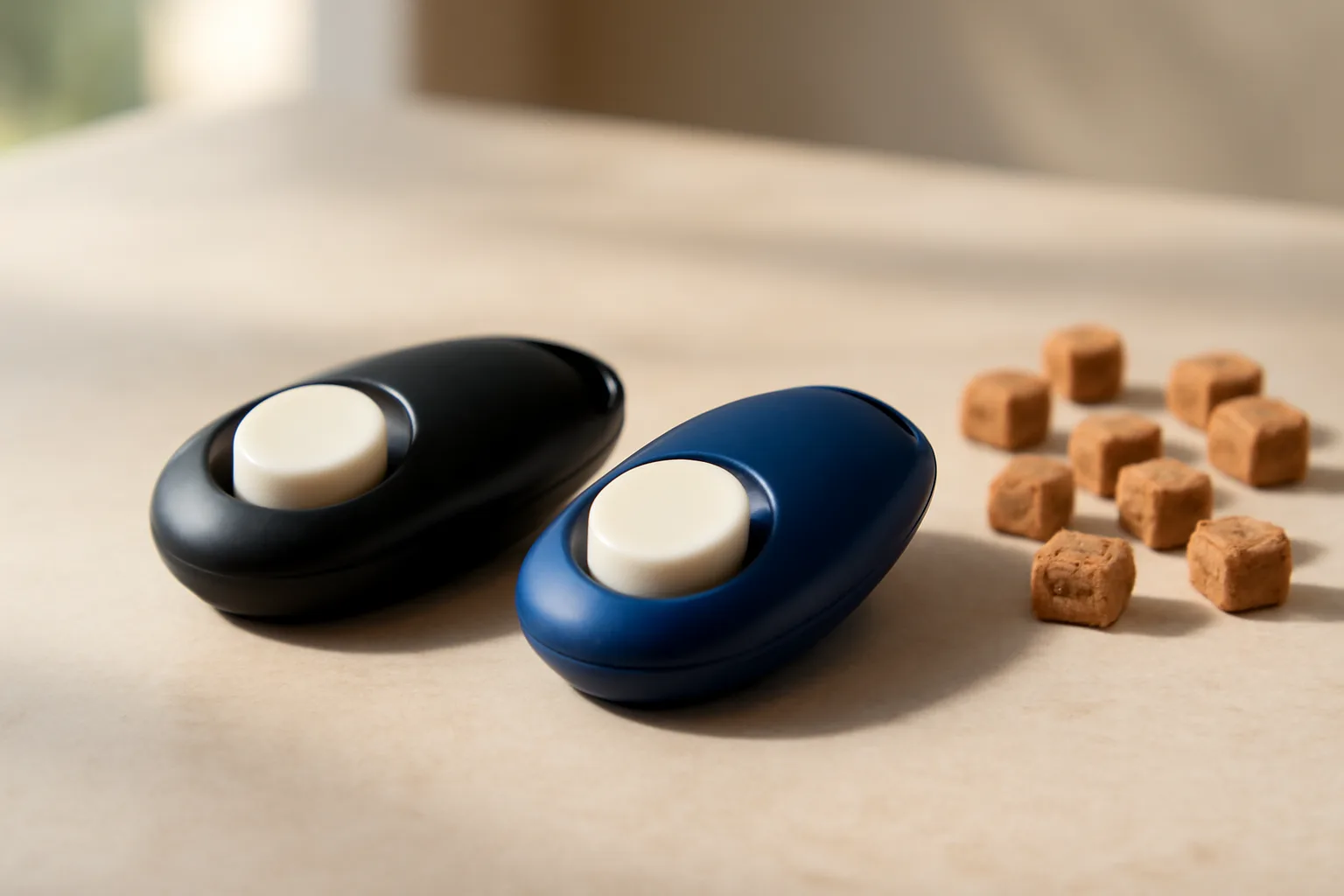
Four dog training clickers worth considering
1. Coachi Multi-Clicker — best adjustable-sound starting point
Coachi’s Multi-Clicker has three volume settings, a raised thumb button and an adjustable wrist strap. Company of Animals confirms those features. That makes it the most flexible of these four when you want to begin at a gentler setting and change the sound for a different environment.
Adjustable does not mean silent or automatically comfortable for a worried dog. Try the quiet setting at a distance, watch your dog’s response and pair each click with a reward. If the dog flinches, a soft verbal marker is a better next step than increasing the volume.
- Choose: you want one clicker with sound options and a wrist strap.
- Skip: your dog is distressed even by the quietest click or you prefer a finger-mounted design.
- Check: that the linked coral/navy variant and volume control match the listing you receive.

2. PetSafe Clik-R — best finger-held choice
The Clik-R’s compact body sits in the palm and its finger band helps keep the button positioned while you handle rewards or a lead. PetSafe’s UK product page confirms the finger strap and included training instructions. This is a handling choice, not a claim that a finger band improves a dog’s learning.
Its click is fixed rather than adjustable, and band comfort varies by hand. The linked purple tool is a single clicker. If sound flexibility matters more than how you hold it, start with Coachi instead.
- Choose: a finger band would help you keep a marker ready.
- Skip: you need a quieter, adjustable sound.
- Check: how the band sits on your finger alongside treats and a lead.

3. Starmark Pro-Training Clicker — best simple single clicker
Starmark’s Pro-Training Clicker is a conventional one-piece marker with a prominent central button. It is a sensible option if you want one easy-to-identify press point and do not need the Coachi volume dial or PetSafe finger band. Starmark also publishes a training guide that explains the click-and-reward sequence.
Its sound is not adjustable. A large button can make handling easier, but it does not establish that the click is suitable for every dog or that the device is more durable than the others—we have not tested either point.
- Choose: you want one basic clicker with a central button.
- Skip: you need volume control, a finger band or a spare unit.
- Check: the sound and grip in the first short session, before using it close to a noise-sensitive dog.

4. Diyife two-pack — best when you need a spare
The linked Diyife set contains two fixed-sound button clickers with wrist straps. A second clicker is useful when two people train the same dog or when you want to keep one near the door and one with your treat pouch. Agree on the same click-then-reward rule between trainers; two devices do not replace consistency.
The two-pack is a convenience choice, not our recommendation for a sound-sensitive dog. If one of the clickers is too sharp for your dog, the spare has the same basic limitation. The linked colours are black and green; do not assume a different colour bundle has the same offer.
- Choose: two trainers or two locations would make a spare useful.
- Skip: you need adjustable volume or prefer one more ergonomic tool.
- Check: the exact black-and-green two-pack and its current offer.

How to use a clicker without confusing your dog
Start somewhere quiet. Click once and promptly give a small reward; repeat this simple pairing before asking for a new behaviour. Then click the instant your dog does the thing you want—such as placing all four paws on the floor—and reward immediately after. The PDSA’s clicker-training guidance explains the marker-and-reward sequence. Our positive-reinforcement guide covers the wider routine.
The click is not a command, recall whistle or correction. Do not click repeatedly to get attention and do not use it to startle or punish. Keep sessions short enough for your dog to stay engaged, and lower the difficulty when they are not succeeding. If fear or reactivity is part of the problem, work at a comfortable distance and consider a qualified reward-based professional; a clicker alone is not a behaviour-treatment plan.
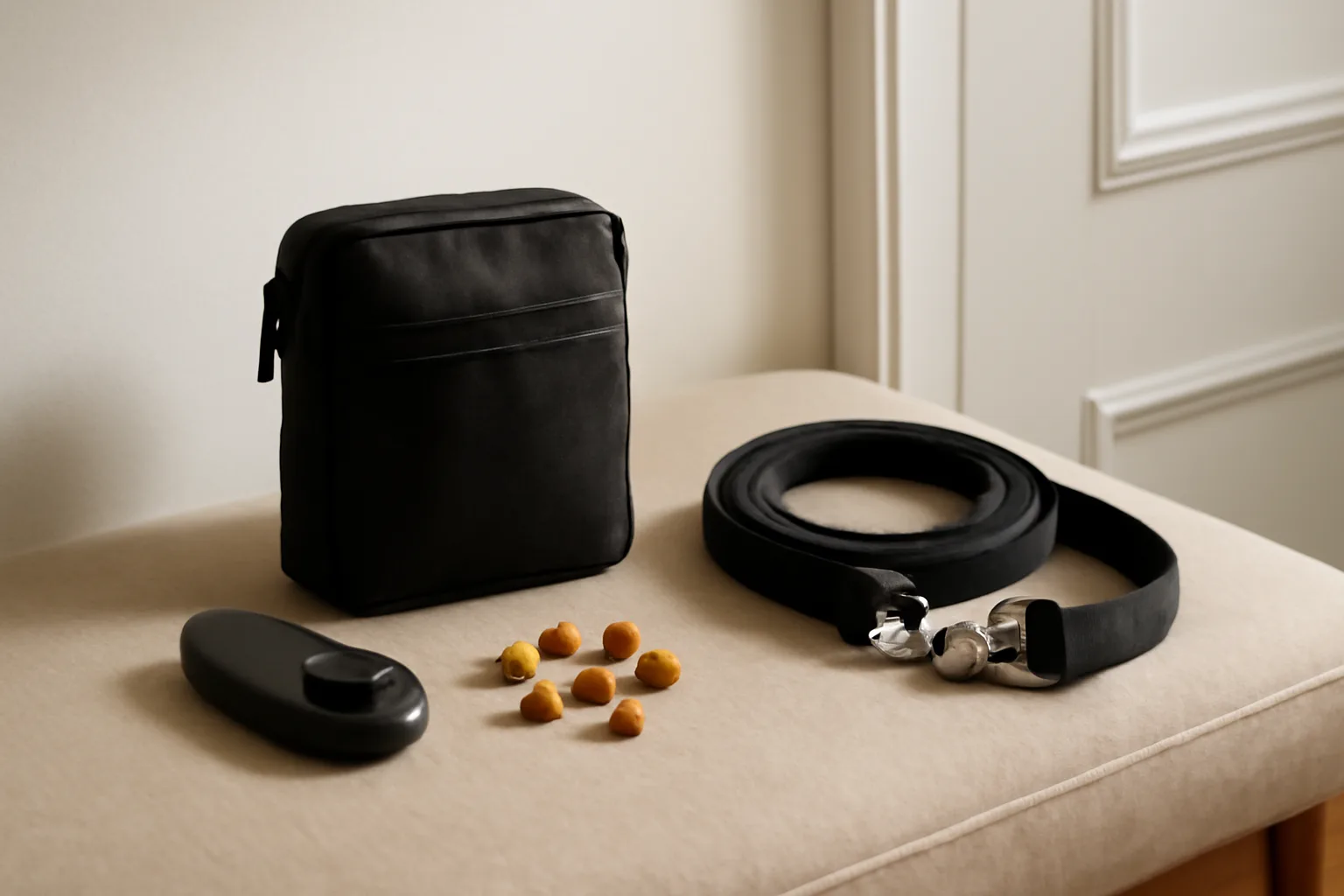
Sound, grip and buying checks
Sound: begin with the quietest workable marker. An adjustable dial gives options, but a verbal “yes” can be gentler than a mechanical click. Do not equate a louder click with more effective training. Listen for your dog’s body language and move away from the sound if needed.
Grip: rehearse holding the clicker, treats and lead without your dog present. A finger band, wrist strap or big button can help different hands. Think about gloves and wet-weather use if you mostly train outdoors; none of these clickers is being claimed waterproof here.
Consistency: if more than one person trains your dog, use the same marker rule and reward timing. A spare clicker may help, but a consistent spoken word can also work. For loose-lead work, see our lead-training guide; the marker supports the lesson rather than replacing it.
The bottom line
Start with Coachi Multi-Clicker if adjustable sound is useful. Switch to PetSafe Clik-R for finger-held convenience, Starmark Pro-Training for a simple single clicker, or the Diyife two-pack for spares. A comfortable sound and well-timed reward are the real buying test.
Frequently asked questions
Which clicker should I buy for a puppy?
A clicker you can press comfortably and use at a volume your puppy accepts is a good starting point. Coachi offers three sound settings; begin quietly and pair every click with a small reward. A softly spoken marker is also an option if the click worries your puppy.
How do I introduce a clicker?
In a quiet place, click once and give a reward promptly. Repeat until the sound predicts something good, then click the moment your dog offers a simple behaviour and reward afterwards. Keep the early sessions short.
Is a finger clicker better than a wrist-strap clicker?
A finger band keeps the PetSafe Clik-R close to the hand while you manage treats or a lead. A wrist strap can suit someone who wants to let go of the tool between repetitions. Choose the handling style you can use consistently.
What if my dog is frightened by the click?
Increase distance, reduce volume if your clicker allows it, or switch to a gentle spoken marker. Watch for signs of distress and do not force exposure. For persistent fear, seek tailored help from a qualified reward-based trainer or behaviourist.
Does the click replace a treat?
The click marks the exact moment you want to reinforce. Follow it with a reward, especially while teaching a new behaviour. The sound itself is not a command or a substitute for reinforcement.