The best dog crate is one your dog can stand, turn and stretch in comfortably, in a design that suits where you will use it. For most homes, I would start with a folding wire crate rather than a fabric one: it is easier to clean and harder to damage. A growing puppy may benefit from a divider; a car boot needs a separate fit check. None of the crates below is a shortcut around gradual training or a reason to leave a dog shut in for hours.
Our top 5 dog-crate picks
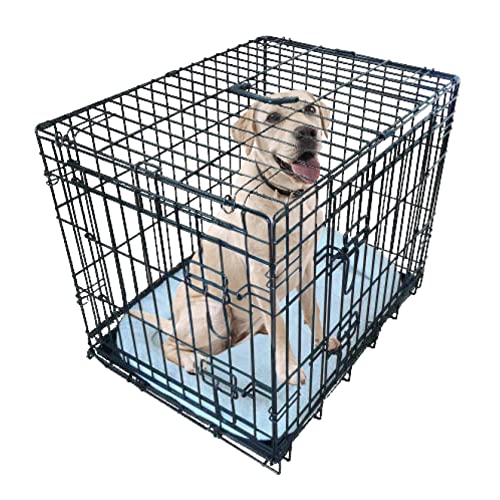
Ellie-Bo Black Deluxe 30-inch two-door
Best everyday folding crate
Two doors make room placement easier; a metal tray and mat come with this 76.2 × 53.3 × 59.7 cm crate.

MidWest iCrate 36-inch single-door
Best for a growing puppy
The included divider adjusts the usable space while the puppy grows; measure the dog before choosing the 92.7 cm crate.

Feandrea heavy-duty 107 cm crate
Best sturdier home crate
A steel frame, five latches and a pull-out tray suit a permanent home setup, but stronger hardware is not a treatment for distress.

Feandrea 76 cm soft travel crate
Best portable fabric crate
Folds down for trips and temporary indoor use with a crate-comfortable dog; fabric is a poor match for persistent chewers.

Pet World 36-inch sloped car crate
Best for a measured car boot
The sloped steel shape and sliding door may suit a hatchback boot, provided both the dog and vehicle fit are checked first.
In This Article
- Comparison at a glance
- Five dog crates reviewed
- How to choose the right crate size
- Which crate type suits your home
- Travel and car-crate checks
- Introduce a crate without forcing it
- Before you order
- The bottom line
- Frequently asked questions
Comparison at a glance
| Crate | Best use | External size | Main compromise |
|---|---|---|---|
| Ellie-Bo Deluxe | Everyday folding wire crate | 76.2 × 53.3 × 59.7 cm | No divider included in this variant |
| MidWest iCrate | Puppy crate with divider | 92.7 × 59 × 62.9 cm | One door; check where it will face |
| Feandrea heavy-duty | Sturdier fixed home setup | 107 × 70 × 76.6 cm | Bulky and not a behaviour treatment |
| Feandrea soft travel | Portable, temporary indoor setup | 76.2 × 53.4 × 53.4 cm | Fabric can be chewed or clawed |
| Pet World sloped | Measured hatchback/estate boot | 91 cm wide; 61 cm base depth; 63 cm high | Not proven crash-tested |
Those are external measurements, not usable internal floor space. Measure your dog and the intended spot, then check door swing, access and the seller’s full dimensions. A product labelled “large” is not a size recommendation.
Five dog crates reviewed
1. Ellie-Bo Black Deluxe 30-inch: best everyday folding crate
The Ellie-Bo is the sensible first look if you need a conventional home crate. This exact black Deluxe medium version has two doors, a metal tray and a bed mat, so it can sit across a corner without making the only entrance face the wrong way. It folds when you need floor space back. At 76.2 × 53.3 × 59.7 cm externally, it will suit only a dog that has enough room inside to stand and stretch; the “medium” label is not a substitute for measuring.
The metal tray is a practical advantage when cleaning up a puppy accident. The trade-off is the open wire design: some dogs settle better with part of the crate covered, but the cover must not block ventilation. This selected version does not claim an included divider. If you need one for a puppy, budget for a compatible divider or choose the MidWest below.
- Choose it if: you want a foldable two-door wire crate for everyday indoor use.
- Skip it if: the dog’s measurements need a larger usable interior or a divider is essential.
- Main compromise: two-door convenience does not replace careful sizing.
2. MidWest iCrate 36-inch: best divider-equipped puppy crate
This 36-inch iCrate includes a divider panel and tray. The divider lets you reduce the usable space while a puppy grows, without buying a series of increasingly large crates. Its stated external size is 92.7 × 59 × 62.9 cm. Start by measuring the expected adult dog and checking the actual internal space; a divider cannot make an undersized crate appropriate later.
The selected B000OXAES6 is the single-door variant. That is fine when the door can face an open part of the room, but it matters beside furniture or in a narrow utility area. If the dog is already full grown, the divider is less of a reason to pay for this one. For house-training help beyond the crate itself, see our puppy house-training guide.
- Choose it if: you want a wire crate that can be adjusted during puppy growth.
- Skip it if: the single door will be blocked where the crate must sit.
- Main compromise: a divider is useful, but the adult-size fit still comes first.

3. Feandrea heavy-duty 107 cm: best sturdier home crate
The Feandrea uses a steel frame with five L-shaped locks, a pull-out tray and removable door and roof sections. Those are meaningful differences from a basic folding wire cage if the crate will stay in one place and you want more substantial hardware. The 107 × 70 × 76.6 cm external footprint is large: mark it on the floor before ordering, including space to open the door and remove the tray.
“Heavy-duty” does not mean indestructible or safe to use as an escape-proof solution for a distressed dog. Repeated attempts to force a door can cause injury. If your dog panics when confined, pause crate use and speak to a vet or qualified behaviour professional rather than buying a stronger box. This model is also much less convenient to move around the house than the folding wire choices.
- Choose it if: you need a larger, sturdier fixed crate and your dog is comfortable being crated.
- Skip it if: your concern is separation distress or you need a lightweight travel crate.
- Main compromise: stronger hardware costs floor space and portability.
4. Feandrea 76 cm soft crate: best portable fabric option
A soft crate is easy to carry and store. This Feandrea variant is 76.2 × 53.4 × 53.4 cm externally, with mesh panels, folding frame, mat and multiple openings. It makes sense as a familiar resting place on a visit or in temporary accommodation once the dog is already happy inside a crate. Set it up before the trip, rather than asking a dog to accept both a new crate and a new place at once.
Fabric and zips are a poor match for a dog that chews, scratches or pushes hard at an enclosure. Despite the product’s travel wording, do not assume it is a crash-rated car restraint. Its value is portable accommodation, not a guarantee of vehicle protection. For a washable base at home, compare the dimensions with a suitable dog bed or crate mat.
- Choose it if: your dog is crate-comfortable and you need something that folds for visits.
- Skip it if: your dog chews fabric or needs a sturdier daily crate.
- Main compromise: low weight comes with less resistance to damage.
5. Pet World 36-inch sloped: best measured car-boot choice
The sloped rear of this steel crate is designed for a hatchback or estate boot. The external dimensions given for the selected 36-inch version are 91 cm wide, 63 cm high, 61 cm deep at the base and 30 cm deep at the top. It folds flat and has a sliding front door, which may be easier to use where a swinging door would foul the boot lip. Measure the boot opening, floor, tailgate slope and the dog’s usable interior space before you order.
The maker describes car use, but that does not establish independent crash-test performance. Treat it as a vehicle-fit candidate, not a proven crash-safety winner; ask for exact-model test evidence if that matters to you. It must be installed so it cannot move around, following the manufacturer’s instructions. If the vehicle cannot accommodate an appropriately sized crate, compare other restraint options in our dog car-safety guide.
- Choose it if: a measured boot and your dog both suit this sloped size.
- Skip it if: you need documented crash-test performance or cannot secure it in the vehicle.
- Main compromise: a plausible boot shape does not prove fit or crash protection.
How to choose the right crate size
Measure the dog, not the breed
Measure the dog standing from floor to the top of the head or ears, and from nose to the base of the tail. Then allow enough usable space to stand and sit without touching the top, turn around, lie on the side and stretch. PDSA’s crate advice also allows room for bedding and water. Exterior dimensions in a product title include the frame and are not the interior dimensions your dog experiences.
Fit the room as well
Tape the crate footprint on the floor and leave clearance for the door, tray and airflow. Put it somewhere quiet and draught-free but not isolated from the household. Avoid direct sun and radiators. If the dog is still growing, choose for their eventual size and use a suitable divider if needed; do not let the divider crowd a dog that has grown past it.
Which crate type suits your home
Folding wire for most homes
Wire is the practical default: ventilation, visible doors and removable trays make everyday use simpler. Ellie-Bo’s two doors help with placement; MidWest’s divider helps during growth. Neither feature makes the wrong-size crate right. A securely draped cover can make a corner feel quieter, provided the dog cannot pull it through the bars and ventilation stays clear.
Heavier steel for a fixed spot
The Feandrea heavy-duty model makes sense if you have room for a substantial permanent crate. It is not a behavioural tool. If a dog is trying to escape in a panic, start with the cause of the distress. Our dog-calming aids comparison explains why products are no substitute for a plan tailored to the dog.
Fabric for a settled traveller
Soft sides are convenient when you need a temporary resting place that packs down. Use them with dogs that already settle calmly and do not damage fabric. A soft crate is not the default first crate for a puppy who has never been left inside one.

Travel and car-crate checks
Measure the boot before buying a car crate
The relevant measurement is not just boot width. Check the opening, slope with the tailgate shut, seat-back angle, usable floor depth and where the crate door can open. You also need a crate your dog can use comfortably. The Pet World’s sloped roof may help in some estates and hatchbacks, but it is not a universal car fit. Confirm how the crate is restrained in the vehicle; an unsecured cage can shift in a stop.
Restraint is not the same as a crash certificate
Highway Code rule 57 says animals should be suitably restrained so they cannot distract the driver or be injured in a sudden stop; a cage is one possible method. That does not mean every cage has independently demonstrated crash protection. Ask for test evidence for the exact model if that matters to your purchase, and do not treat a soft holiday crate as a vehicle safety product.
Introduce a crate without forcing it
Start with the door open
Place bedding inside, secure the door open and let the dog investigate at their own pace. Reward voluntary entry and calm settling. Only close the door briefly after the dog is comfortable entering, then build duration gradually. Our positive-reinforcement guide has more on rewarding the behaviour you want rather than forcing it.
Watch for distress and keep time sensible
A crate should be a resting space, not a punishment or a substitute for company, exercise and toilet breaks. PDSA advises against keeping a dog in a crate for more than three hours at a time, and less while they are learning. Puppies often need much more frequent breaks. If the dog barks continuously, drools, hurts themselves or refuses to enter, step back and seek veterinary or qualified behaviour advice. Do not solve that by locking a stronger door.
Before you order
- Size: compare the dog’s standing and stretched-out measurements with usable internal space, not only the exterior label.
- Doors and access: check door direction, furniture clearance and whether a boot lip blocks a travel-crate opening.
- Cleaning: check that the tray removes easily and that bedding can be washed.
- Setup: allow safe airflow and a calm position; check how a car crate is secured.
- Returns: read the seller’s terms before assembling a large crate, especially if fit is uncertain.
Do not order by a breed chart alone. Two dogs of the same breed can differ enough in height and length to need different crates. A crate is a useful purchase only when both the dog and the place it will be used have been measured.
The bottom line
For a typical indoor setup, I would choose the Ellie-Bo 30-inch Deluxe if its measured interior suits the dog: the two-door layout and metal tray are useful every day. Choose the MidWest iCrate instead when a growing puppy needs its included divider and the single door works in the room. The Feandrea heavy-duty, soft Feandrea and Pet World car crate each solve a narrower job; none should be bought simply because it sounds tougher or more travel-ready.
Frequently Asked Questions
How big should a dog crate be? The dog should be able to stand and sit without touching the top, turn around, lie comfortably and stretch out. Measure the dog and check the usable interior, not just the exterior product size.
Should I buy a puppy crate with a divider? A divider can make an adult-size crate more practical while the puppy grows. Move it as the dog grows and check that the crate will still be large enough for the adult dog.
Can a dog sleep in a soft crate? A crate-comfortable dog that does not chew fabric may settle in a soft crate. It is a poor choice for a dog that scratches or tries to escape, and it is not automatically a car-safety restraint.
Will a heavy-duty crate stop separation anxiety? No. A stronger door does not address distress and could increase the risk of injury if a dog tries to escape. Speak to a vet or qualified behaviour professional about the cause.
Is any dog crate safe for the car? A suitably fitted and secured cage can restrain a dog, but that is not proof of independent crash-test performance. Check vehicle fit, the maker’s securing instructions and exact-model test evidence before relying on a crate for travel.
How long can a dog stay in a crate? It depends on the dog and their training, but PDSA advises no longer than three hours at a time and less for a dog not used to a crate. Puppies need more frequent toilet and interaction breaks.